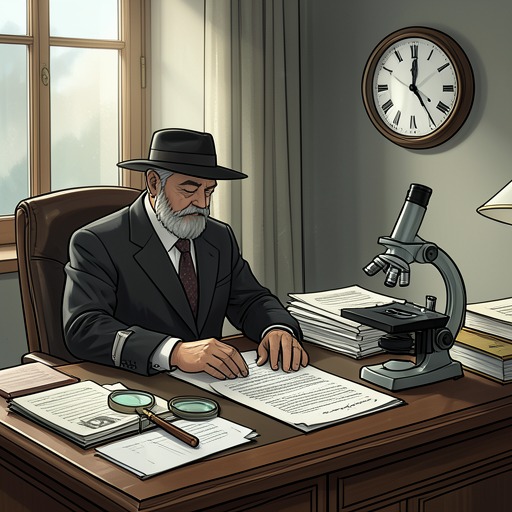
Darren Clements’s ricin-pellet attacks
Blow OutDarren Clements’s ricin-pellet attacks are a series of poisonings whose investigation turns on distinguishing the actual weapon from plausible alternatives and tracing the means of attack back to Darren. The eventual evidence links a castor bean and a workshop in his rented garage to the concealed air rifle he used for the attacks, while the investigation’s changing conclusions show how physical traces and careful comparison gradually expose the method behind them.
Background and Investigative Uncertainty
The inquiry initially considered whether a long rifle could have fired the recovered pellets. At the stables, investigators checked Clements’s alibi with the owner and the grooms who were present. Their inquiries established that he could not possibly have fired the shots unless he had access to a helicopter. Jo nevertheless presented the visit as an investigation of mistaken identity: she did not want to destroy the refuge Clements had made for himself if he had already suffered enough. Her restraint reflected a distinction between suspicion and proof, but it also left a potentially important lead untested at that point.
Carly asked why Jo had not taken the rifle away for forensic comparison with the two recovered pellets. The question pointed to a gap between what the investigation suspected and what it could establish. Later, forensic findings clarified why the rifle Jo had seen at James Campbell’s cottage could not be the weapon used in the attacks. The recovered pellets bore neither rifling marks nor gunpowder residue; experts also judged that even a suppressed shot from the proposed rifle would have made a more evident noise. The evidence instead pointed to a standard air rifle or a target air pistol.
The Garage and the Poison
A search of the rented garage brought the inquiry into a workshop fitted out for practical work. It contained a full-width workbench with electrical sockets, a vertical drill, two vices, boxed power-drill sets, a large granite mortar and pestle, and a kettle. Metal shelving along one wall was empty. Two tall lockers stood against another wall, one of them holding an all-in-one white biohazard suit like the one Jo was wearing during the search. These objects and the workshop’s arrangement gave the investigators reason to focus on the garage, though Jo kept excitement in check: finding incriminating material was not the same as having the suspect in custody.
Under the workbench stood a locked grey fireproof safe, about a foot wide and eight or nine inches deep. As Jo shifted to stand, something pressed into her knee. She picked up a small oval object, less than half an inch long, grey with brown markings and a protrusion at one end. She identified it as a castor bean, Ricinus communis, and explained that chewing and swallowing five could likely be fatal. The discovery linked a specific source material to the poison investigation. Jo contrasted the seeds with the powdered form favoured by the attacker, which was more versatile for delivering poison to a victim.
Weapon, Identity, and Method
The later account resolves the question of how Darren acquired the weapon. After his sister died, his father’s departure was the trigger for Darren’s next steps. He joined a gun club shortly afterward under the name Jordan Springer and bought the air rifle through the club. This detail connects a concealed identity to the practical acquisition of the weapon: the gun was not simply found in the garage but obtained through a false name and an organized route.
The air rifle, rather than the air pistol seen at the Trafford Centre, was the weapon Darren had used for all the earlier attacks. Investigators found it in a homemade rack beneath the workbench in the garage he was renting. The distinction matters because the pistol’s appearance at the later confrontation could have obscured the continuity of the attacks. The rifle’s concealment in the same workshop where the castor bean was found brought weapon and poison-related evidence together in one place.
Findings and Consequences
The investigation’s conclusions grew out of several different kinds of evidence: the alibi check at the stables, forensic examination of the pellets, the castor bean and equipment in the garage, and the account of how Darren obtained the rifle. Each corrected an earlier uncertainty. The stables inquiry made his involvement appear physically impossible under the initial assumptions; ballistics eliminated the long rifle; and the garage evidence ultimately identified an air rifle as the weapon used throughout the attacks.
The case’s method is therefore revealed not by a single decisive clue but by the convergence of objects and circumstances. The pellets lacked the marks and residue expected from the suspected rifle; the castor bean gave the investigators a tangible link to ricin; and the homemade rack beneath the workbench concealed the rifle that the later investigation identified as the weapon. Together, these findings turn the garage from a collection of workshop equipment into the material centre of the attacks and establish Darren’s role through evidence that had first been obscured by disguise, uncertainty, and competing weapon theories.